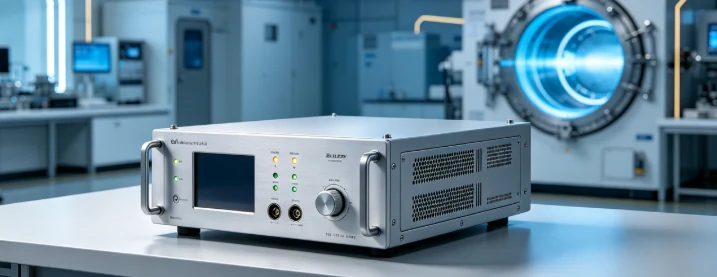
Next-Generation Remote Plasma Technology for Advanced Semiconductor Processing
Conventional magnetron-based microwave remote plasma sources have been widely used for plasma cleaning and surface treatment. However, conventional magnetron architectures can present limitations in microwave power control, response, system footprint and integration flexibility when applied to increasingly demanding semiconductor processes.
SEMIVAC Solid-State Microwave Remote Plasma Source adopts an advanced solid-state microwave architecture to provide more precise microwave power control, improved process stability, compact system integration and greater flexibility for advanced plasma applications.
Key Technology Comparison
| Feature | Magnetron-Based Microwave RPS | SEMIVAC Solid-State Microwave RPS |
|---|---|---|
| Microwave Source | Conventional magnetron | Advanced solid-state microwave source |
| Power Control | Conventional power regulation | High-precision and fast-response control |
| Plasma Stability | Suitable for general plasma applications | Enhanced stability and repeatability |
| Power Response | Relatively slower response | Fast and precise response |
| System Architecture | Conventional and relatively bulky | Compact and highly integrated |
| Process Control | Limited process flexibility | Fine control of plasma process parameters |
| Equipment Integration | Higher space and integration requirements | Flexible integration with process chambers |
| Application Range | Cleaning and surface treatment | Cleaning, ashing, etching, deposition-related processes and advanced surface treatment |
| Semiconductor Compatibility | Primarily conventional plasma applications | Designed for advanced semiconductor process integration |
The SEMIVAC Advantage
Precision-Controlled Remote Plasma
The key advantage of SEMIVAC's solid-state microwave RPS lies not simply in generating plasma, but in providing precise and controllable plasma conditions.
High-resolution microwave power control enables more accurate adjustment of plasma supporting demanding semiconductor processes that require high generation conditions, levels of stability, repeatability and process control.
Compact and Highly Integrated Design
The solid-state microwave architecture enables a more compact system configuration compared with conventional magnetron-based solutions.
Its compact design facilitates integration with existing or newly developed vacuum process chambers while reducing equipment footprint and installation constraints.
Fast Response and Process Repeatability
Solid-state microwave technology enables rapid adjustment of microwave power, providing greater responsiveness to process changes.
This capability can contribute to improved plasma stability, process repeatability and production consistency.
Remote Plasma for Advanced Processes
Because the plasma is generated remotely from the processing region, the RPS architecture can deliver reactive species to the process chamber while reducing direct exposure of the microwave source to the process environment.
This makes remote plasma particularly attractive for applications such as:
- Plasma cleaning
- Photoresist stripping / ashing
- Surface treatment
- Wafer cleaning
- Chamber cleaning
- Etching-related processes
- Pre-treatment and post-treatment
- Plasma-enhanced deposition processes
From Conventional Microwave Plasma to Precision-Controlled Remote Plasma
Magnetron-based RPS provides plasma generation. SEMIVAC Solid-State Microwave RPS provides precision plasma control.
With its combination of high-precision power control, fast response, stable plasma generation, compact architecture and flexible integration, SEMIVAC's Solid-State Microwave Remote Plasma Source provides a next-generation platform for advanced semiconductor and industrial plasma applications.
Precision Plasma. Stable Process. Compact Integration.
From Remote Plasma Generation to Precision Plasma Control.
面向先进半导体工艺的下一代远程等离子体技术
传统的磁控管式微波远程等离子体源已广泛应用于等离子体清洗与表面处理。然而,当应用于日益严苛的半导体工艺时,传统磁控管架构在微波功率控制、响应速度、系统占地与集成灵活性等方面可能显现局限。
SEMIVAC 固态微波远程等离子体源采用先进的固态微波架构,提供更精确的微波功率控制、更优的工艺稳定性、紧凑的系统集成,以及面向高级等离子体应用的更大灵活性。
关键技术对比
| 特性 | 磁控管式微波 RPS | SEMIVAC 固态微波 RPS |
|---|---|---|
| 微波源 | 传统磁控管 | 先进固态微波源 |
| 功率控制 | 传统功率调节 | 高精度、快速响应控制 |
| 等离子体稳定性 | 适用于一般等离子体应用 | 稳定性与重复性更优 |
| 功率响应 | 响应相对较慢 | 快速、精确响应 |
| 系统架构 | 传统且相对庞大 | 紧凑、高度集成 |
| 工艺控制 | 工艺灵活性有限 | 精细控制等离子体工艺参数 |
| 设备集成 | 占地与集成要求更高 | 与工艺腔室灵活集成 |
| 应用范围 | 清洗与表面处理 | 清洗、灰化、刻蚀、沉积相关工艺与先进表面处理 |
| 半导体兼容性 | 主要用于常规等离子体应用 | 面向先进半导体工艺集成设计 |
SEMIVAC 优势
精确可控的远程等离子体
SEMIVAC 固态微波 RPS 的核心优势不仅在于产生等离子体,更在于提供精确、可控的等离子体条件。
高分辨率微波功率控制能更精确地调节等离子体,支撑对生成条件、稳定性、重复性与工艺控制要求严苛的半导体工艺。
紧凑、高集成设计
与传统磁控管式方案相比,固态微波架构可实现更紧凑的系统配置。
其紧凑设计便于与现有或新开发的真空工艺腔室集成,同时降低设备占地与安装约束。
快速响应与工艺重复性
固态微波技术可快速调节微波功率,对工艺变化响应更灵敏。
这有助于提升等离子体稳定性、工艺重复性与生产一致性。
面向先进工艺的远程等离子体
由于等离子体在远离工艺区域处产生,RPS 架构可将反应活性物种输送到工艺腔室,同时减少微波源直接暴露于工艺环境。
这使得远程等离子体特别适合以下应用:
- 等离子体清洗
- 光刻胶剥离 / 灰化
- 表面处理
- 晶圆清洗
- 腔室清洗
- 刻蚀相关工艺
- 前处理与后处理
- 等离子体增强沉积工艺
从传统微波等离子体到精确可控的远程等离子体
磁控管式 RPS 提供等离子体生成;SEMIVAC 固态微波 RPS 提供精确的等离子体控制。
凭借高精度功率控制、快速响应、稳定的等离子体生成、紧凑架构与灵活集成,SEMIVAC 固态微波远程等离子体源为先进半导体与工业等离子体应用提供了下一代平台。
精确等离子体。稳定工艺。紧凑集成。
从远程等离子体生成,到精确等离子体控制。