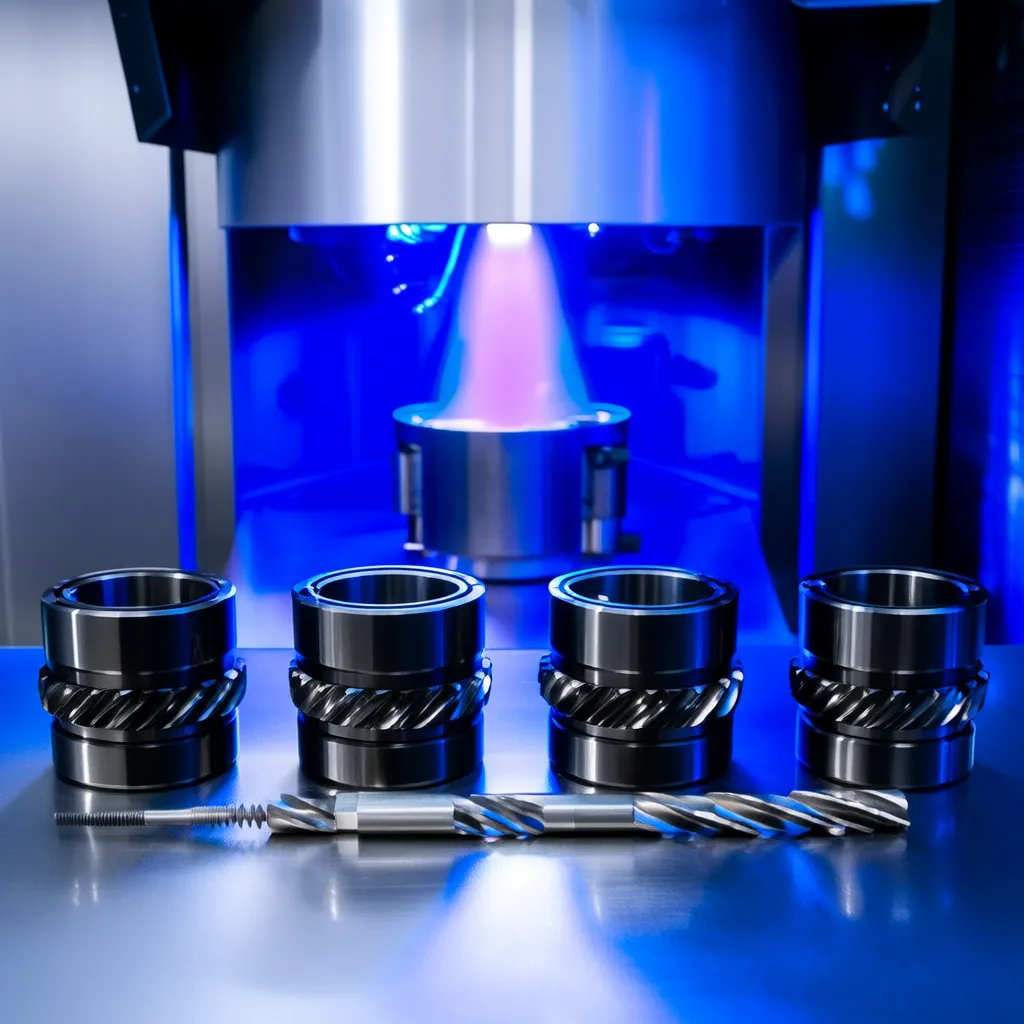
Diamond-like carbon, abbreviated as DLC, is a metastable amorphous carbon thin film with a long-range disordered structure. Carbon atoms are connected via covalent bonds, mainly consisting of two hybrid bonds: sp² and sp³ (hydrogen-containing DLC films also contain a certain amount of C–H bonds). This unique structure endows it with the outstanding properties of both diamond and graphite.
Classification of DLC films
DLC films are categorized into hydrogen-free DLC films and hydrogen-containing DLC films based on the preparation process:
- Hydrogen-free DLC films are mostly fabricated by Physical Vapor Deposition (PVD), with typical methods including vacuum cathodic arc deposition and pulsed laser deposition.
- Hydrogen-containing DLC films are generally prepared by Chemical Vapor Deposition (CVD). Acetylene (C₂H₂) is introduced during deposition, so a certain amount of C–H bonds exist in the structure.
Hydrogen-free DLC films fall into two types: a-C films (a 3D network mixed with sp³ and sp² bonded carbon atoms) and Tetrahedral Amorphous Carbon films, abbreviated as ta-C. Hydrogen-containing films (a-C:H) contain C–H bonds in their 3D network, where sp² bonds account for the majority — such films are generally softer than ta-C, and C–H bonds tend to decompose at high temperatures, giving inferior temperature and oxidation resistance compared with hydrogen-free films.
What makes ta-C special
ta-C, full name "Tetrahedral Amorphous Carbon Coating", is an amorphous diamond film fabricated by coating technologies such as Filtered Arc (FA), which can form sp³ hybrid bonds with a diamond phase content up to 88%.
The coating features low deposition temperature, ultra-high hardness, excellent adhesion, low friction coefficient and stable chemical properties.
It is widely applied to oil-free lubrication components including hard disk magnetic heads, glass molds, printer parts, cutting tools, military components, medical devices, automobile engine parts and textile machinery.
Engineered performance
DLC is a family of carbon-based coatings — not a single coating type. Its properties can be tailored by adjusting hydrogen content, doping elements, coating structure and deposition process. Typical coating thickness is 1–5 μm, with hardness ranging from 8 to over 80 GPa, providing:
- Excellent wear resistance
- Low friction
- High hardness
- Improved corrosion resistance
- Longer component service life
By incorporating DLC coatings during the design stage, manufacturers can improve component reliability, reduce maintenance and enhance overall system performance across demanding industrial applications.
类金刚石,简称 DLC,是一种亚稳态的非晶碳薄膜,具有长程无序结构。碳原子通过共价键连接,主要由两种杂化键组成:sp² 和 sp³(含氢 DLC 薄膜中还含有一定数量的 C–H 键)。这种独特结构使其兼具金刚石与石墨的优异性能。
DLC 薄膜的分类
根据制备工艺的不同,DLC 薄膜分为无氢 DLC 薄膜与含氢 DLC 薄膜:
- 无氢 DLC 薄膜多采用物理气相沉积(PVD)制备,典型方法包括真空阴极弧沉积与脉冲激光沉积。
- 含氢 DLC 薄膜一般通过化学气相沉积(CVD)制备,沉积过程中引入乙炔(C₂H₂),因此结构中存在一定数量的 C–H 键。
无氢 DLC 薄膜分为两类:a-C 薄膜(sp³ 与 sp² 键合碳原子混合的 3D 网络)和四面体非晶碳薄膜,简称 ta-C。含氢薄膜(a-C:H)的 3D 网络中含有 C–H 键,其中 sp² 键占多数——此类薄膜通常比 ta-C 软,且 C–H 键在高温下容易分解,因此其耐温性与抗氧化性不如无氢 DLC 薄膜。
ta-C 的独特之处
ta-C,全称"四面体非晶碳涂层",是通过过滤电弧(FA)等镀膜技术制备的非晶金刚石薄膜。FA 技术可形成 sp³ 杂化键,金刚石相含量最高可达 88%。
该涂层具有沉积温度低、超高硬度、附着力优异、摩擦系数低、化学性质稳定等特点。
它广泛应用于无油润滑部件,包括硬盘磁头、玻璃模具、打印机零件、切削刀具、军工部件、医疗器械、汽车发动机零件与纺织机械等。
工程化性能
DLC 是一个碳基涂层家族,而非单一涂层类型。可通过调整含氢量、掺杂元素、涂层结构与沉积工艺来定制性能。典型涂层厚度为 1–5 μm,硬度范围为 8 至 80+ GPa,可提供:
- 优异的耐磨性
- 低摩擦系数
- 高硬度
- 更好的耐腐蚀性
- 更长的部件使用寿命
在设计阶段引入 DLC 涂层,制造商可提升部件可靠性、降低维护成本,并在严苛工业应用中提升整体系统性能。